




Site-Directed Modification of mRNA with Functionalized Platinum(IV)–Ammines
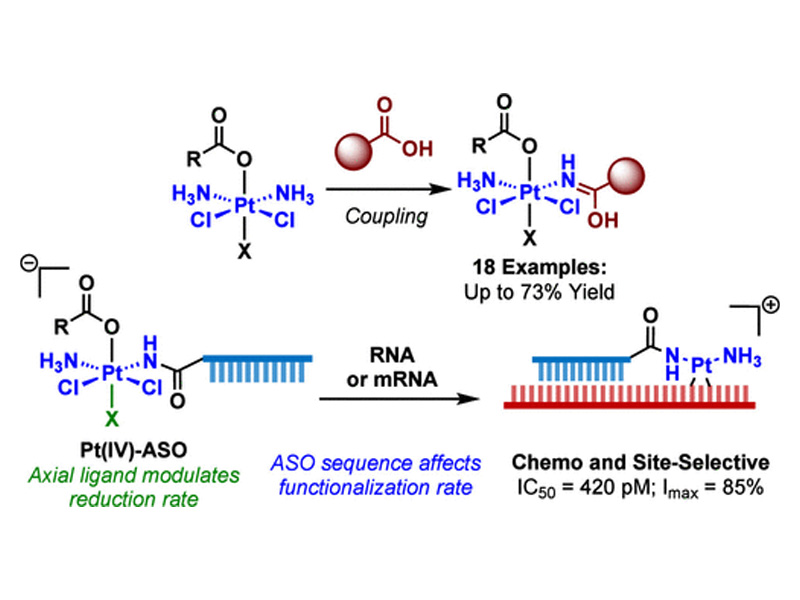
Site-Directed Modification of mRNA with Functionalized Platinum(IV)–Ammines
Edward Miller, Charlotte E. Farquhar, Jacob Rodriguez, Andrei Loas, Bradley L. Pentelute
Abstract
Developing chemical toolkits for mRNA modification has remained an immense challenge, driven by the inherent difficulties in targeting mRNA molecules. Antisense oligonucleotides (ASOs) offer a promising framework for targeting specific mRNA sequences, yet they do not possess the capacity to alter the structure of mRNA except through enzyme-mediated hydrolysis. We developed a platinum(IV)–ASO strategy that combines the sequence specificity of ASOs with the reactivity of platinum to functionalize nucleic acids, including short RNA and mRNA, in a selective enzyme-free manner. Access to Pt(IV)–ASO constructs was made possible by an equatorial Pt(IV) ammine derivatization strategy, allowing for the conjugation of carboxylic acids directly to the Pt core. Reactivity with 21-mer RNA and full-length mRNA by Pt–ASO constructs was demonstrated, and the conjugated products were characterized using a suite of orthogonal techniques, such as electrophoretic mobility shift assay, MALDI-TOF MS, temperature-dependent dissociation assay, and RT-qPCR. Constructs were optimized for their reactivity and selectivity, allowing for Pt(IV)–PMO constructs with subnanomolar IC50 values in an RNA competition assay. This Pt(IV)–ASO platform facilitates new avenues for RNA modification by providing a strategy for functionalizing nucleic acids with potential applications in molecular biology research.