



In vivo antibody-selective conjugation technology for long-acting drugs
In vivo antibody-selective conjugation technology for long-acting drugs
Katsushi Kitahara, Aurélie Rondon, Edward Miller, Howard H. Mak, Andrei Loas, Bradley L. Pentelute
Abstract
A key limitation for peptide drugs is their rapid degradation within minutes after intravenous (i.v.) administration. New methods are desired to increase the half-life of peptides in blood, thus maintaining their therapeutic effect longer and reducing repeated dose-related toxicity. An efficient strategy to achieve this goal leverages covalent attachment of peptides to immunoglobulin G antibodies (IgGs). IgGs, due to their large size and recycling properties, circulate in the blood for days. Conjugating peptide drugs to IgGs is expected to protect them from degradation. However, the use of exogeneous, engineered IgGs poses a risk, in terms of compatibility, for the host immune system.
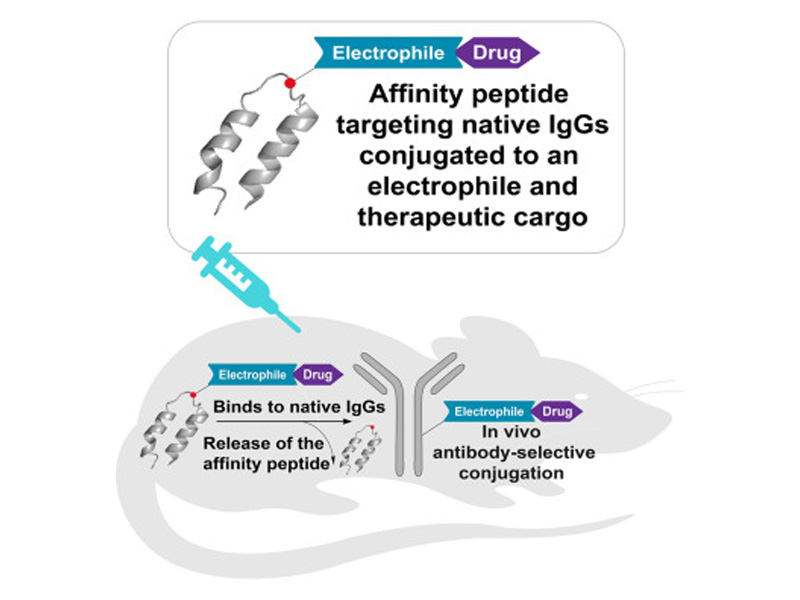
We describe an innovative conjugation technology that introduces an efficient way to covalently attach peptide and small-molecule therapeutic payloads to endogenous circulating IgGs already produced by the host organism. To demonstrate efficacy of this original antibody-selective conjugation technology, a proof of concept was performed with the glucagon-like peptide-1 (GLP-1), a peptide found in commercially widespread drugs used for managing type 2 diabetes and obesity. In vivo studies confirmed IgG-only modification associated with sustained GLP-1 efficacy over time. Conjugating therapeutics directly to native IgGs that are already available and circulating inside the body represents a significant achievement for the drug development field by eliminating exogenous antibody production and engineering costs as well as lowering the risks for inducing immunogenicity. This work may thereby pave the way for designing next generations of long-acting drugs for a broad range of human diseases.